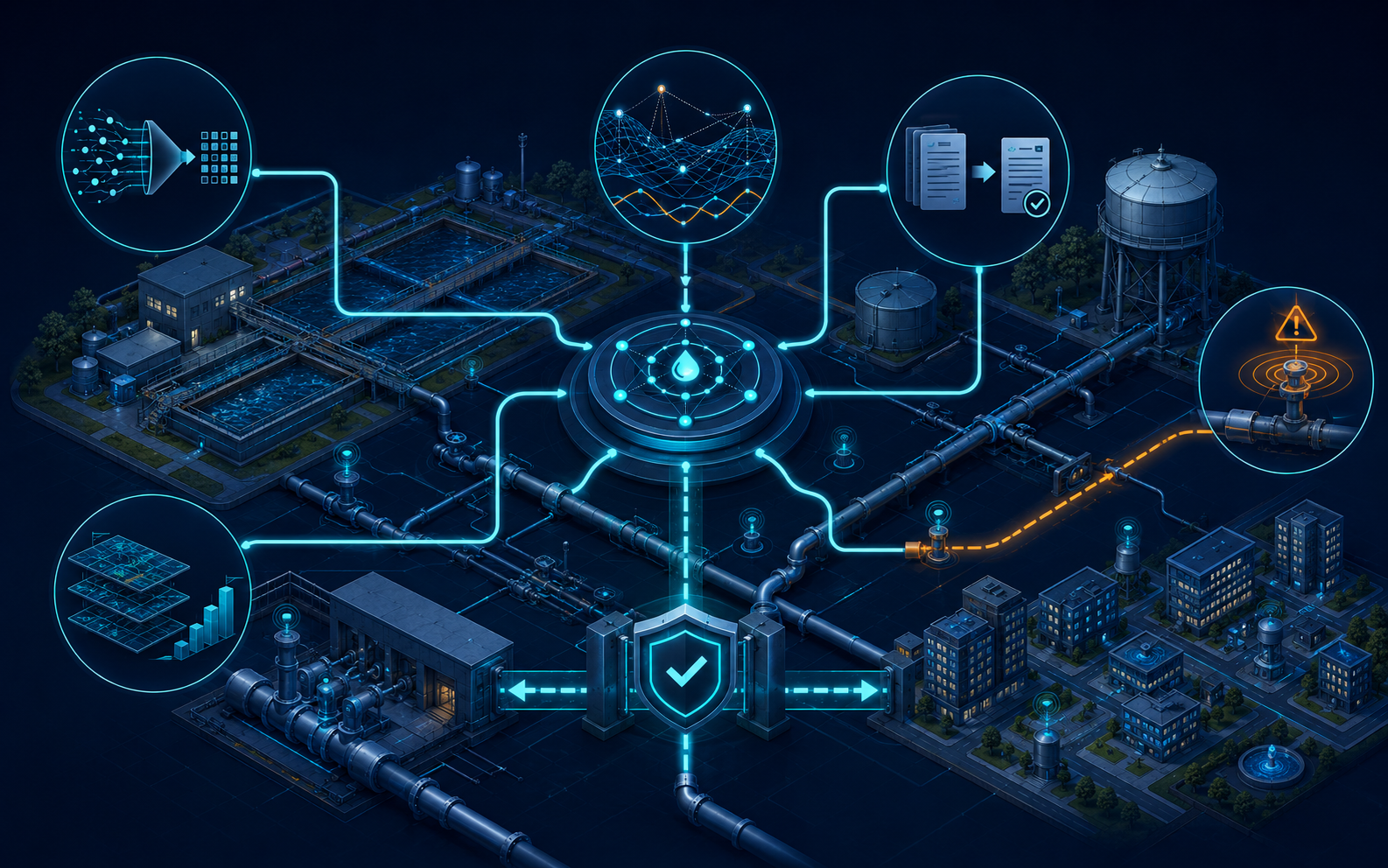
AquaTwinX connects engineering models, utility knowledge, asset intelligence, operations, and capital strategy across drinking water, wastewater, stormwater, and water reuse.
01ONE WATER SYSTEM INTELLIGENCE
Digital Twins
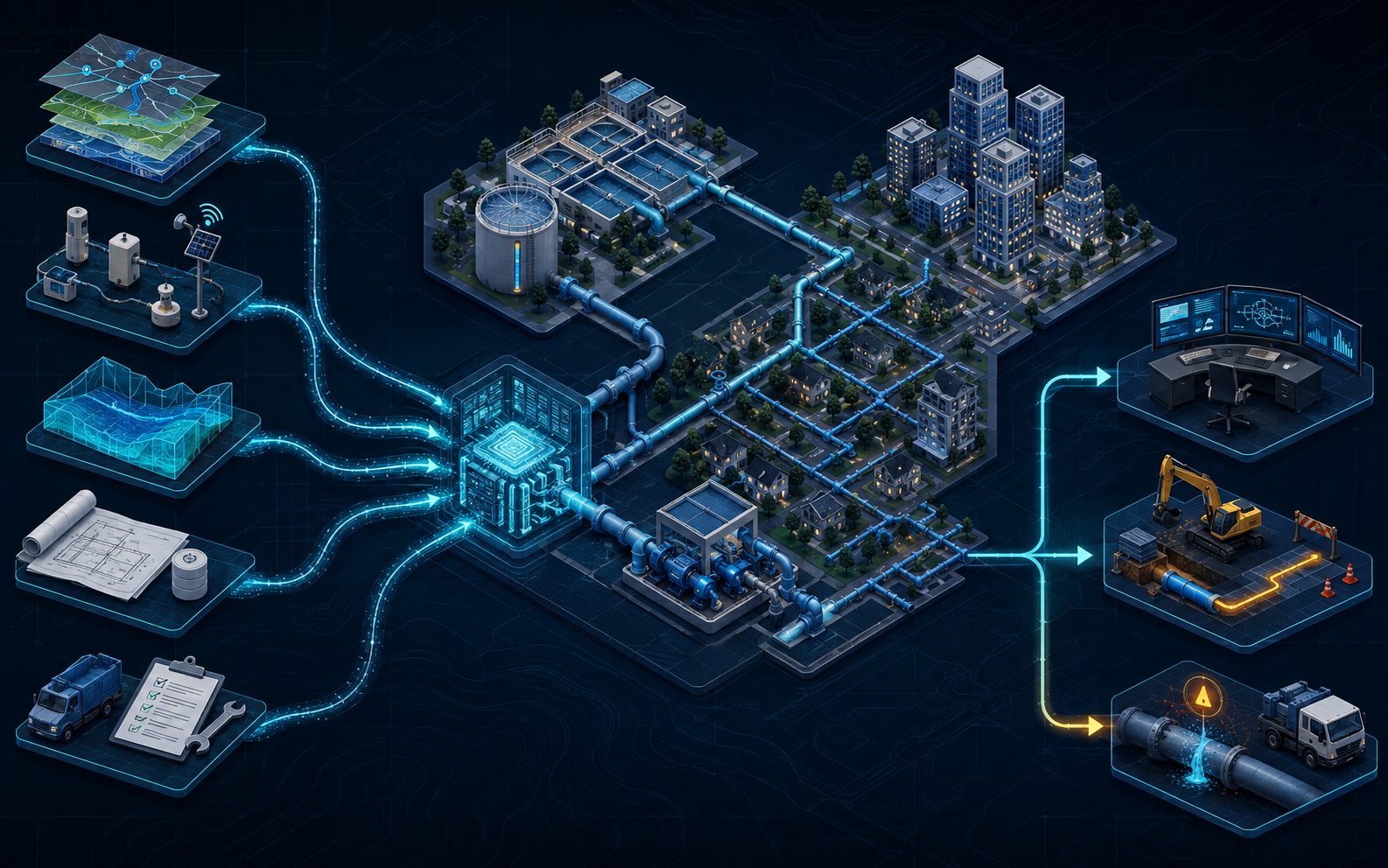
Connect drinking-water, wastewater, stormwater, and water-reuse assets, telemetry, operating rules, and engineering models within a living system representation.
The Utility Challenge
Facilities and networks are commonly managed through separate GIS, SCADA, work-management, laboratory, and modeling environments. This limits visibility into how treatment, pumping, storage, collection, detention, control, and reuse decisions interact across the urban water cycle.
AquaTwinX Approach
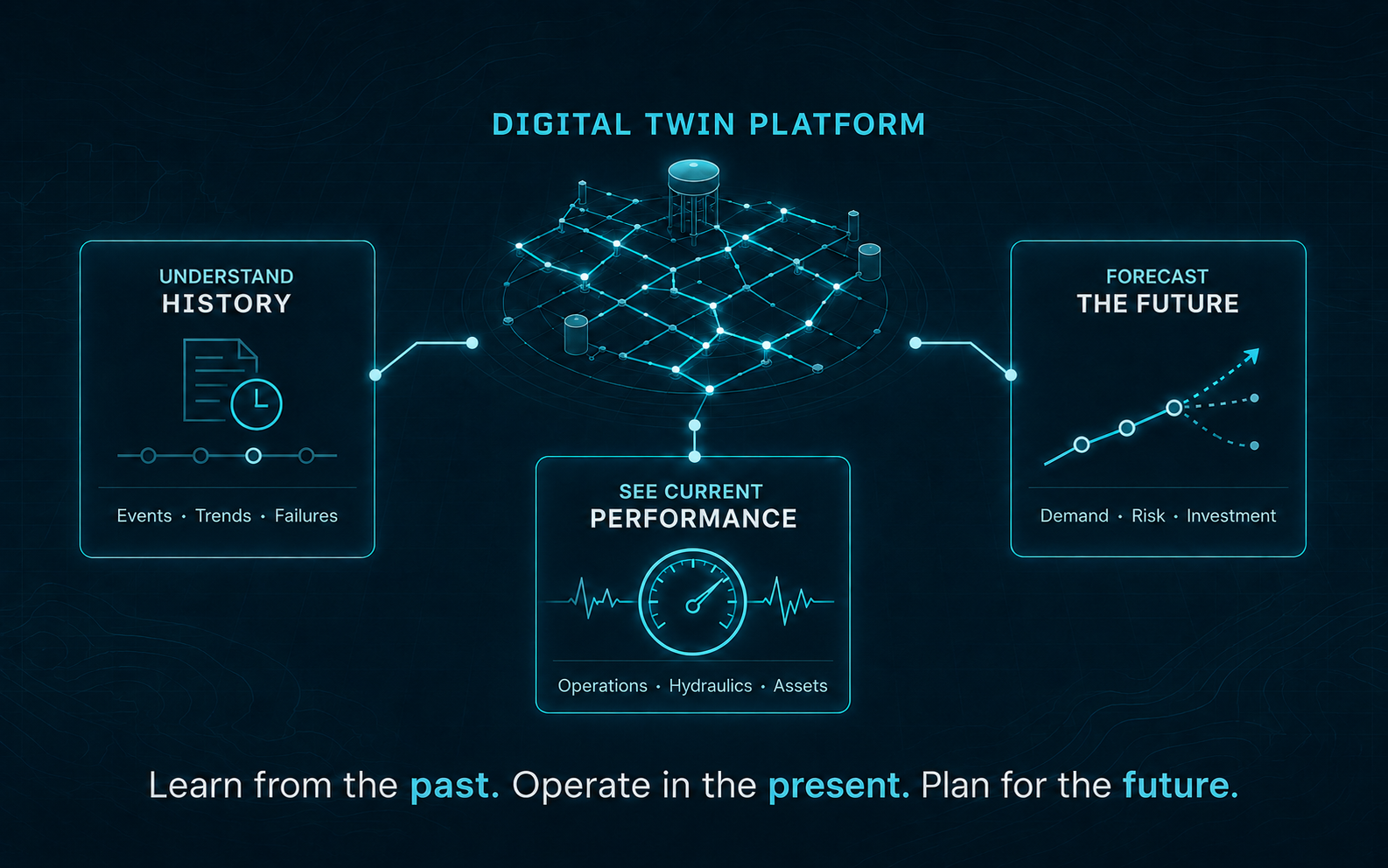
AquaTwinX organizes approved sources around shared facility, network, and watershed context. The twin supports historical reconstruction, current-condition awareness, and future scenario evaluation while authoritative systems, engineering validation, and operational approval remain intact.
Principal Capabilities
Drinking-water, wastewater, stormwater, and reuse integration
Treatment, pump, storage, basin, gate, and network interactions
Historical reconstruction and current system visibility
Hydraulic, hydrologic, operational, and investment scenarios
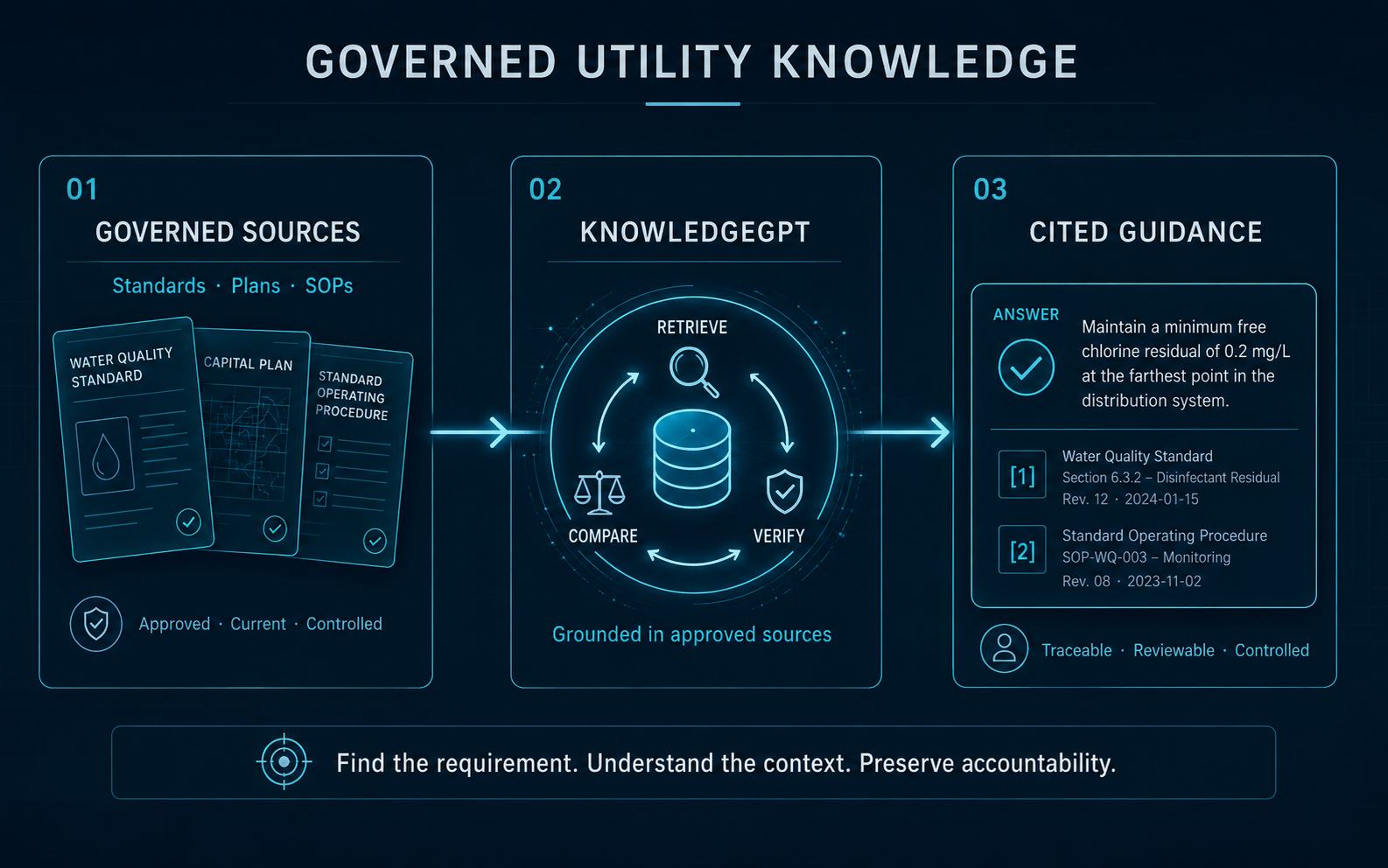
Provide rapid, traceable answers grounded in approved utility standards, plans, reports, procedures, regulations, and engineering records.
The Utility Challenge
Critical engineering knowledge is dispersed across extensive document collections and often depends on a small number of experienced staff. Conventional search returns files; it does not reliably synthesize applicable requirements or explain their context.
AquaTwinX Approach
KnowledgeGPT retrieves relevant passages from governed sources, distinguishes authoritative requirements from supporting guidance, and presents concise responses with citations. Review controls and source ownership preserve professional accountability.
Principal Capabilities
Permission-aware retrieval from approved technical sources
Traceable answers with document and section citations
Comparison of standards, alternatives, and historical assumptions
Knowledge-gap identification and controlled content review
Translate asset risk, system performance, resilience, equity, cost, and implementation constraints into a transparent capital improvement program.
The Utility Challenge
Capital programs are often assembled from disconnected needs lists, localized complaints, model results, and expert judgment. Without a common decision structure, priorities can be difficult to defend and update.
AquaTwinX Approach
Smart CIP combines likelihood of failure, consequence, hydraulic deficiency, regulatory need, community impact, cost, and project readiness. Scenario controls show how priorities change under alternative budgets and policy objectives.
Principal Capabilities
Multi-criteria risk and consequence scoring
Project bundling, dependency, and readiness assessment
Budget-constrained portfolio optimization
Scenario comparison and transparent priority rationale
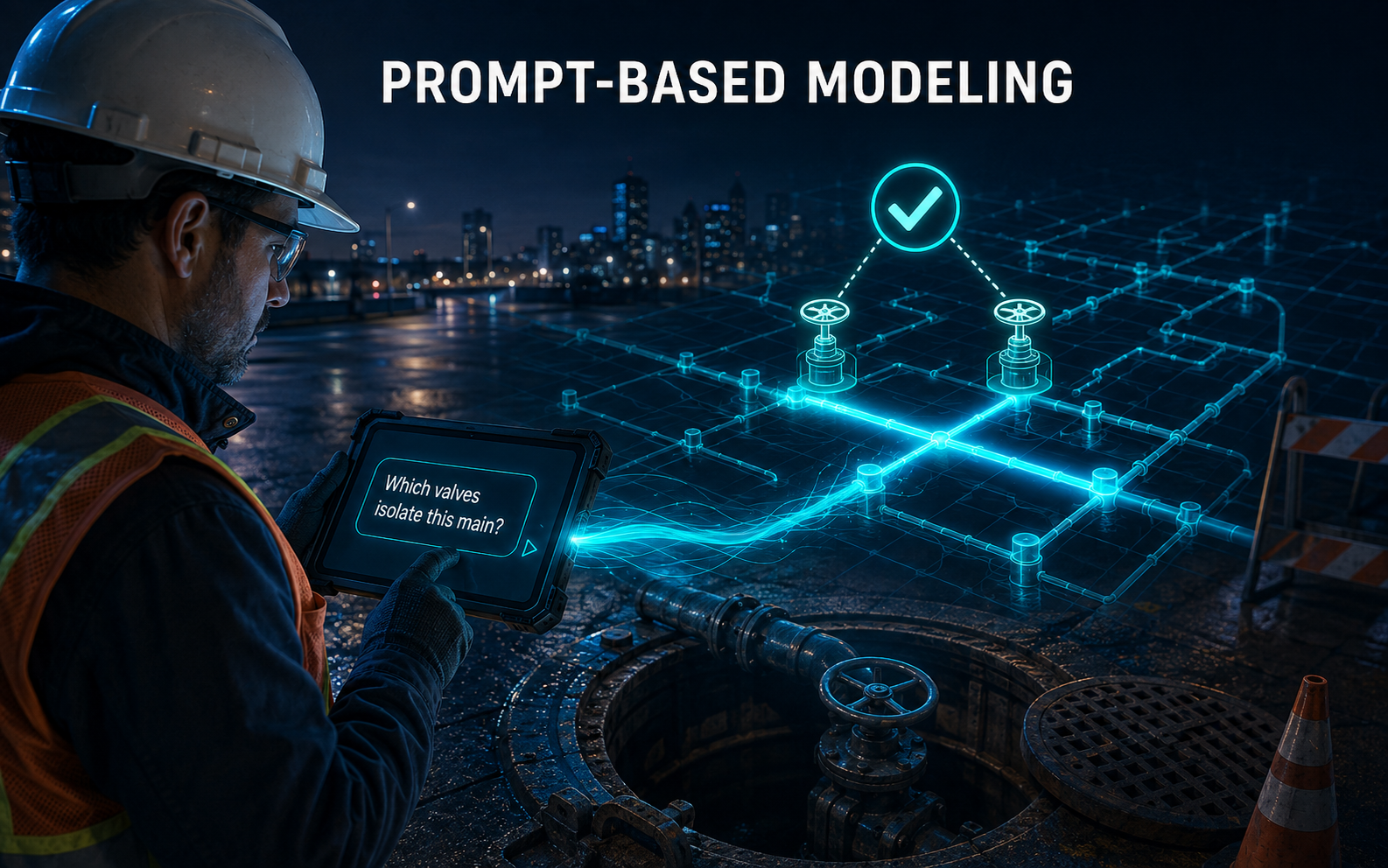
Convert structured natural-language requests into repeatable hydraulic, spatial, and asset analyses while retaining engineering governance.
The Utility Challenge
Hydraulic and geospatial models contain substantial decision value, but specialist availability and software complexity can delay routine operational and planning questions.
AquaTwinX Approach
Users describe the required analysis—such as valve isolation, customer impacts, fire flow, pressure, or demand scenarios. AquaTwinX translates the request into controlled model operations, validates required inputs, and returns mapped results with assumptions and limitations.
Principal Capabilities
Valve-isolation and affected-customer analysis
Fire-flow, pressure, demand, and outage scenarios
Automated model input validation and result summarization
Reproducible analysis records for professional review
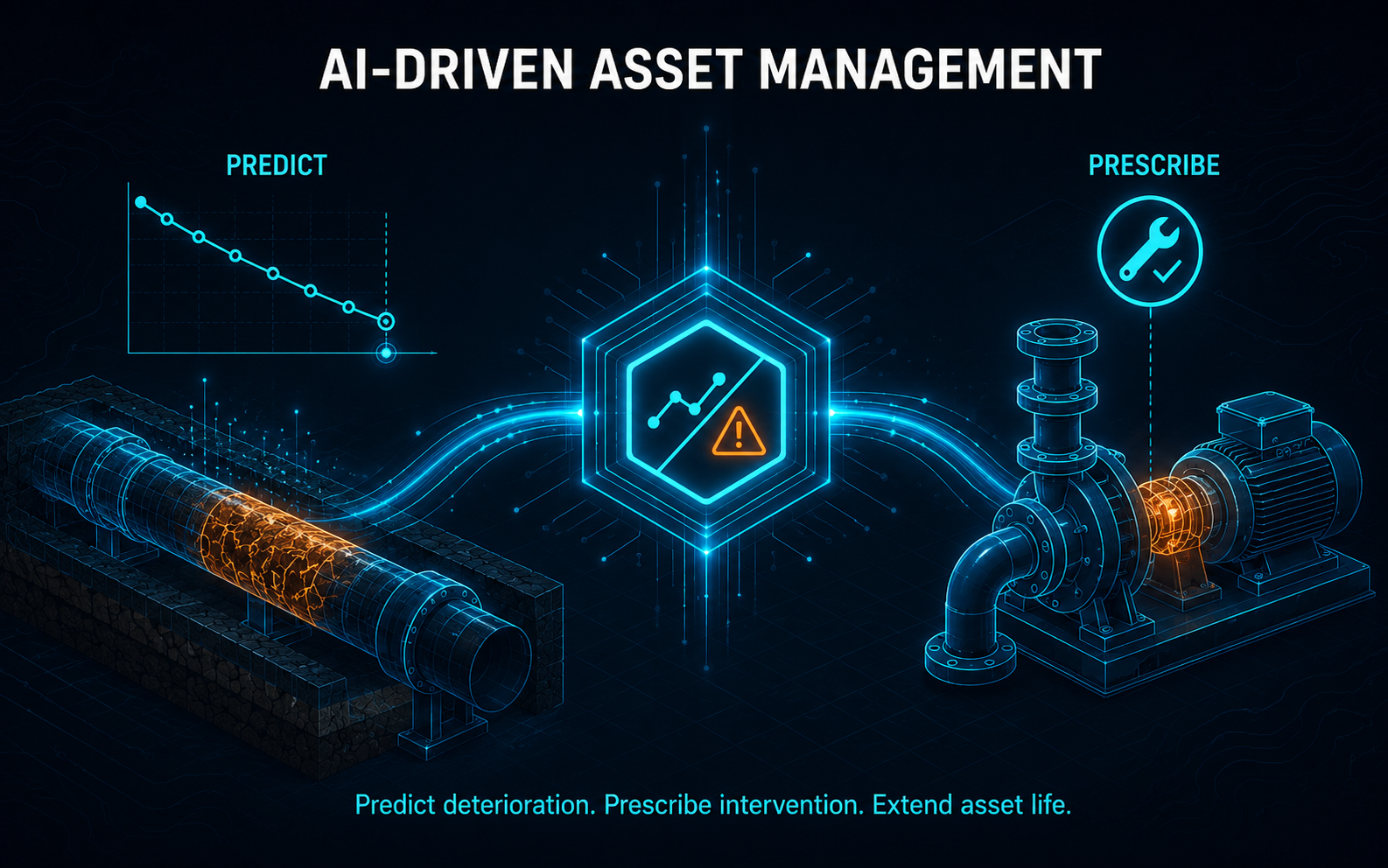
Forecast condition and failure risk for horizontal networks and vertical facilities, then identify the most appropriate intervention and timing.
The Utility Challenge
Age-based replacement programs do not adequately represent actual deterioration, operating stress, environmental exposure, failure history, consequence, or maintenance effectiveness.
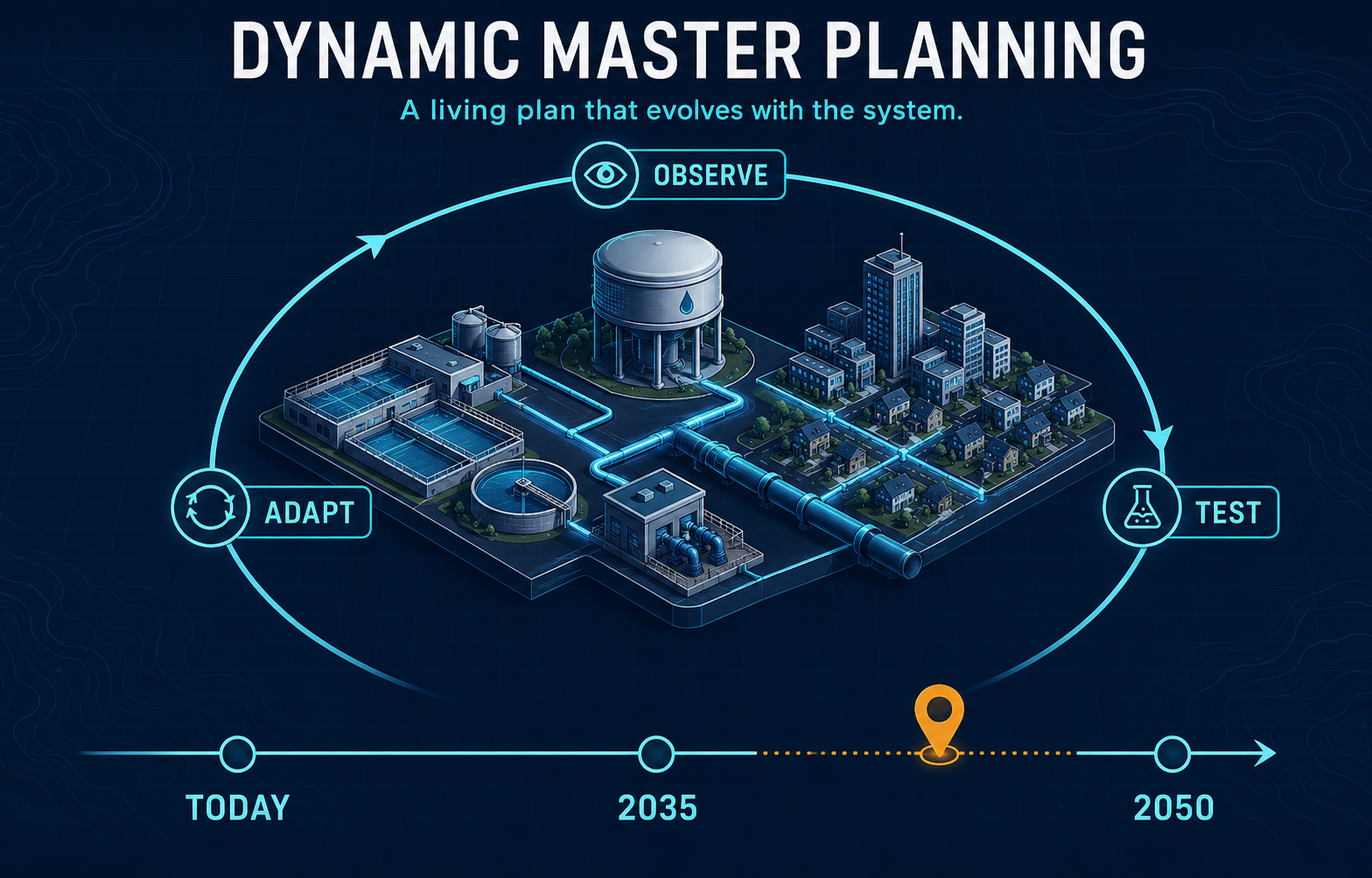
Continuously update system needs, scenarios, projects, priorities, and investment strategies as growth, climate, assets, operations, and funding conditions change.
The Utility Challenge
A conventional master plan is a periodic snapshot. Its assumptions, projects, and priorities may become outdated well before the next planning cycle, weakening its value for annual capital and operational decisions.
AquaTwinX Approach
Dynamic Master Planning connects demand, hydraulic performance, asset risk, resilience, development, projects, cost, and policy objectives in an updateable decision environment. Changes are evaluated without rebuilding the planning process from the beginning.
Principal Capabilities
Living demand, supply, capacity, and risk baselines
Growth, drought, outage, climate, and investment scenarios
Continuous project need, timing, and dependency evaluation
Alignment of master planning, CIP, operations, and performance reporting
03Continuous alignment between strategy and delivery
07GOVERNED AUTONOMOUS UTILITY WORKFLOWS
AI Agents
Coordinate specialized AI agents that monitor information, validate evidence, execute bounded technical tasks, and prepare traceable recommendations for professional review.
The Utility Challenge
Utility decisions often require repetitive coordination across data quality, hydraulic models, technical documents, operational signals, work history, and planning scenarios. Manual handoffs delay analysis, while unconstrained automation introduces unacceptable technical and governance risk.
AquaTwinX Approach
AquaTwinX assigns clearly defined responsibilities to specialized agents operating within approved data, tools, permissions, and decision thresholds. An orchestration layer coordinates their work, records the evidence and assumptions used, and routes consequential recommendations through engineering or operational review before action.
Principal Capabilities
Data QA/QC, reconciliation, and exception identification
Hydraulic-model calibration, validation, and controlled scenario execution
Governed knowledge retrieval with source-grounded technical synthesis
Anomaly monitoring, planning analysis, and human-review escalation
Begin With a Decision. Build the Required Intelligence.
AquaTwinX solutions can be introduced independently and connected progressively. Implementation begins with a defined utility decision, uses the systems and data already available, and expands only where additional capability creates measurable value.
01Define
Establish the decision, users, evidence, and performance objective.
02Connect
Organize authoritative data, models, documents, and workflows.
03Demonstrate
Deliver a focused use case with transparent assumptions and validation.
04Scale
Extend the operating model through governance, training, and measured adoption.
BUILD THE NEXT ONE WATER DECISION CAPABILITY
Start With the Problem Your Utility Needs to Solve.
Define a focused utility decision, identify its evidence and governance requirements, and demonstrate measurable value before scaling.