End-to-End Utility Transformation

Transform Utility
Data Into
Defensible Decisions.

AquaTwinX unifies trusted data, advanced modeling, digital twins, governed AI, and dynamic planning for water and wastewater utilities.

Begin with one consequential decision. Build the data, engineering intelligence, applications, governance, and workforce required to improve it.

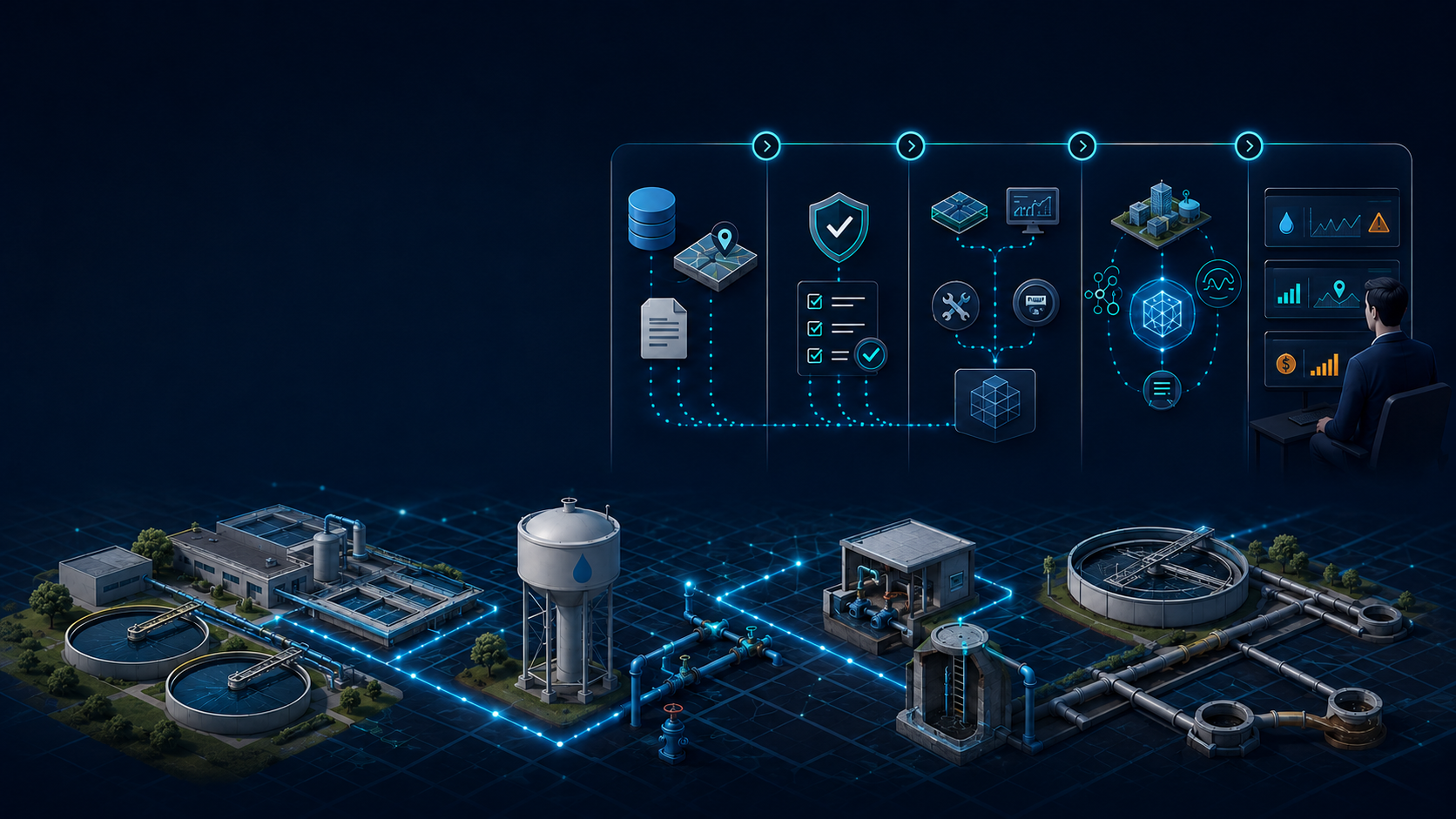
CatalogCleanIntegrateApplyDecide
Data cataloging, quality control, integration, digital twin and AI applications supporting utility decisions

Trusted Data Connected Intelligence Decision-Ready Utility

ENGINEERING-LEDUtility transformation grounded in infrastructure planning, modeling, operations, and accountable professional judgment
STANDARDS-ALIGNEDImplementation informed by established water-sector, AI-governance, data, and cybersecurity frameworks
DECISION-FOCUSEDMethods designed around traceable evidence, governed workflows, and defensible utility decisions
Review our principles

One Urban Water Cycle. One Coordinated Decision Environment.

Data establishes context; models represent system behavior; digital twins connect history, current performance, and possible futures; governed AI assists analysis; and scenario planning translates evidence into operational actions and capital priorities across drinking water, wastewater, stormwater, and water reuse.

01System SignalsGIS, SCADA, AMI, assets, models, and documents
02Utility IntelligenceConnected context, analysis, risk, and engineering logic
03Defensible ActionOperational, planning, and capital decisions teams can explain

A Practical Route From Fragmentation to Utility Intelligence.

AquaTwinX is not a disconnected dashboard or isolated AI product. The operating model connects data foundations, engineering analysis, governed applications, organizational adoption, and measurable decisions.

  1. 01Discover & Govern

    Catalog systems, assets, documents, models, ownership, quality, lineage, and decision requirements.

  2. 02Clean & Integrate

    Resolve identifiers, improve data quality, connect authoritative systems, and preserve governance.

  3. 03Model & Understand

    Apply hydraulic, hydrologic, water-quality, risk, and planning models with visible assumptions.

  4. 04Apply Intelligence

    Deploy digital twins, AI agents, KnowledgeGPT, asset intelligence, and decision applications.

  5. 05Decide & Improve

    Support operational, maintenance, capital, and executive decisions—and measure the resulting value.

One Connected Intelligence Ecosystem.

01 / 07

Digital Twins

Connect telemetry, infrastructure data, operating rules, and engineering models across drinking water, wastewater, stormwater, and water reuse to understand facility-to-network interactions before action is taken.

  • Cross-system visibility
  • Facility-to-network scenarios
  • Historical, current, and future intelligence
SEE THE WHOLE SYSTEM
02 / 07

KnowledgeGPT

Give teams traceable access to design standards, master plans, engineering reports, consent decrees, permits, SOPs, regulatory requirements, asset records, and institutional knowledge.

  • Document-grounded responses
  • Source and applicability checks
  • Professional review controls
TURN KNOWLEDGE INTO ACTION
03 / 07

Smart CIP

Prioritize water-main renewal, sewer rehabilitation, drainage improvements, facilities, pump stations, and reuse infrastructure using risk, performance, regulatory exposure, resilience, community impact, and capital constraints.

  • Risk and consequence scoring
  • Cross-sector portfolio optimization
  • Budget and delivery strategy
INVEST WHERE IT MATTERS
04 / 07

Prompt Modeling

Provide controlled plain-language access to approved water, sewer, stormwater, and reuse model workflows while engineering teams retain responsibility for configuration, assumptions, validation, and use.

  • Isolation, pressure, and fire flow
  • Surcharge, detention, and outfall capacity
  • Reuse demand and supply balancing
ASK. MODEL. DECIDE.
05 / 07

AI-Driven Asset Management

Integrate inventory, inspection, condition, work-order, operating, and consequence data for horizontal networks and vertical facilities to support risk forecasting, maintenance priorities, and capital-program development.

  • Networks, facilities, and control assets
  • Condition and risk forecasting
  • Maintenance and renewal priorities
PREDICT. PRESCRIBE. PERFORM.
06 / 07

Dynamic Master Planning

Evolve static planning reports into an adaptive decision environment connecting current performance, growth, climate, operational constraints, deterioration, regulation, project sequencing, and finance.

  • Continuous scenario evaluation
  • Adaptive project timing
  • Living capital strategy
PLAN. ADAPT. DELIVER.
07 / 07

AI Agents

Use governed, task-specific agents for data validation, model preparation, calibration support, scenario execution, exception detection, document review, compliance tracking, and recurring reporting.

  • Auditable bounded workflows
  • Approval and cybersecurity controls
  • Human-review escalation
MONITOR. REASON. ASSIST.

From System Signal
to Defensible Action.

AquaTwinX connects the utility's physical system with its engineering models, enterprise data, knowledge base, and decision workflows.

  1. 01
    ConnectAssets, telemetry, models, documents, and spatial data
  2. 02
    UnderstandSystem state, risk, performance, and uncertainty
  3. 03
    DecidePrioritized, explainable, and repeatable actions
CONNECTEDGIS · SCADA · CMMS
EXPLAINABLESources · Logic · Assumptions
ACTIONABLEOperations · CIP · Strategy
AQUATWINXUtility
Intelligence
KNOWLEDGEStandards · SOPs · Plans
MODELSHydraulic · Risk · Planning
SYSTEMSGIS · CMMS · SCADA · AMI
DECISIONSOperations · CIP · Strategy

Make Every Decision Compound.

01

Faster

Move from fragmented searches and specialist queues to evidence-backed answers at the point of decision.

02

Smarter

Combine engineering judgment with models, asset intelligence, and AI—not disconnected dashboards.

03

Stronger

Create repeatable workflows, governed knowledge, and durable institutional capacity.

Calculate. Simulate. Apply.

Use transparent engineering tools and planned laboratories for water distribution, sewer capacity, stormwater hydrology, treatment and pumping, water reuse, and lifecycle evaluation. Every result retains visible assumptions, limitations, and professional-review requirements.

Authoritative Frameworks for Utility Transformation.

Official guidance and directives supporting responsible digital transformation, data sharing, artificial intelligence, digital twins, and cybersecurity.

Build the Skills Required for Intelligent Infrastructure.

Practice-oriented learning for engineers, utility professionals, students, and technical leaders. The curriculum connects engineering fundamentals with contemporary geospatial, modeling, artificial intelligence, and transformation practices.

01 / 07

PE Civil Exam Preparation

Structured practice, persistent performance records, topic diagnostics, and readiness forecasting for the PE Civil examination.

  • Adaptive Practice Sets
  • Topic-Level Diagnostics
  • Performance & Readiness Analytics
02 / 07

GIS for Infrastructure

Develop applied geospatial capability for asset inventories, network analysis, risk mapping, field workflows, and infrastructure planning.

  • GIS Foundations for Utilities
  • Spatial Analysis & Asset Risk
  • Web GIS, Dashboards & Automation
03 / 07

Hydraulic Modeling

Build practical competency in model development, calibration, scenario analysis, planning, and engineering decision support.

  • WaterGEMS for Water Distribution
  • InfoWorks ICM for Integrated Systems
  • EPANET Modeling & Automation
04 / 07

AI & Machine Learning

Learn the analytical foundations required to prepare data, develop predictive models, evaluate performance, and communicate uncertainty.

  • Applied Machine Learning
  • Predictive & Prescriptive Analytics
  • Responsible AI & Model Evaluation
05 / 07

AI in Water Utilities

Translate artificial intelligence into governed, explainable workflows for operations, planning, asset management, and customer service.

  • Water Utility AI Use Cases
  • Generative AI & Knowledge Systems
  • AI-Driven Asset Management
06 / 07

Digital Transformation

Create an implementation pathway that aligns data, people, governance, technology, and measurable utility outcomes.

  • Digital Strategy & Readiness
  • Digital Twins & Dynamic Planning
  • Governance, Adoption & Value Realization
07 / 07

Utility Simulation & Operations Training

Use guided Digital Twin Lab scenarios to understand how facility operations affect networks, customers, risk, and recovery across the complete urban water cycle.

  • Facility-to-Network Operations
  • Wet-Weather & Emergency Scenarios
  • Digital Twin Decision Laboratories
CONTINUOUS LEARNING MODEL

Foundational instruction → applied exercises → performance evidence → targeted development

Decisions Across the Complete Urban Water Cycle.

Each workflow begins with an operational or planning question, combines approved data and models, and concludes with a reviewable decision record.

Drinking Water

Pressure, storage, and outage management

WorkflowConnect demand, tank, pump, valve, and network-model information.

Decision supportedSupport operating changes, isolation strategy, and service-impact evaluation.

Benefit: improved visibility, preparedness, and defensibility
Wastewater

Wet-weather capacity and SSO-risk reduction

WorkflowEvaluate I&I, wet-well response, surcharge, interceptor capacity, and mitigation scenarios.

Decision supportedSupport operational response and rehabilitation priorities.

Benefit: improved visibility, preparedness, and defensibility
Stormwater

Detention and pump-operation coordination

WorkflowTest rainfall, conveyance, outfall, gate, detention, and pump conditions.

Decision supportedSupport severe-weather operations and drainage investment.

Benefit: improved visibility, preparedness, and defensibility
Water Reuse

Demand and supply balancing

WorkflowCompare reuse demand, treatment output, storage, pumping, and potable-water interactions.

Decision supportedSupport supply allocation and operating strategy.

Benefit: improved visibility, preparedness, and defensibility
One Water

Drought, flood, and capital planning

WorkflowCombine supply, collection, drainage, reuse, asset risk, growth, climate, and finance scenarios.

Decision supportedSupport sequenced, resilient cross-sector investment.

Benefit: improved visibility, preparedness, and defensibility

Build a Practical Path
to One Water Intelligence.

Begin with a platform demonstration, a defined use case, or a focused utility pilot. AquaTwinX can also develop Academy training and customized simulation laboratories using approved utility datasets and models.